
Cognitive health
Brain Fog Over 40: Why Memory Lapses at 47 Aren't 'Just Stress' — and the BDNF Pathway That Actually Reverses It
Brain fog over 40 isn't a memory problem — it's BDNF starvation. Here's what the research actually says, and the cognitive curve that explains the 3pm crash.

You walk into a room and forget why you came in. You read the same email three times. By 3pm your brain feels like it's wrapped in cotton wool, and by 5pm you've given up on anything that requires actual thinking. If you're past 47 and you're nodding along, you've probably been told it's 'just stress' or 'just perimenopause' or 'just the cost of being busy.' Brain fog over 40 is not just any of those things. The research says it's something more specific — and more reversible — than any of them.

Why brain fog over 40 isn't actually a memory problem
When women over 40 say 'my memory is going,' the test results almost never agree. Standard cognitive tests at 47 look identical to what they looked like at 32. The thing that's actually changed isn't long-term memory at all. It's working-memory bandwidth — the amount of information your brain can hold and manipulate at the same time.
Walking into a room and forgetting why is the canonical example. The intention was held in working memory while your brain processed five other things on the walk over. By the time you arrived, the bandwidth had been used up by everything else, and the original thought was simply not retrievable. Long-term memory is fine. The connection that was supposed to retrieve it was busy.
BDNF starvation: the real mechanism behind brain fog over 40
BDNF stands for Brain-Derived Neurotrophic Factor. It's a protein that does one specific job — it lets neurons form new connections to each other. Every time you learn something, every time your brain rewires itself in response to a new experience, BDNF is the molecule that makes the rewiring possible.
BDNF levels decline measurably after 40. A 2014 review in Frontiers in Cellular Neuroscience documented this across multiple studies of midlife adults, particularly in the hippocampus — the brain region that handles working memory and short-term recall. The decline is not catastrophic. It's gradual. But it's enough to change the felt experience of cognition.
Without enough BDNF, your existing neurons are still there. They still fire. But they form new connections more slowly, which means it takes longer to retrieve information that depends on those connections. The lived experience is not a failing memory. It's a slower memory. A foggier memory. A memory that needs more time to find what it's looking for.
What the research actually says about BDNF and cognitive function
The Frontiers review above tracks BDNF as a primary marker of neuroplasticity across the adult lifespan. The NIH National Institute on Aging separately tracks midlife cognitive decline as a real, measurable phenomenon — not the early stage of dementia, but a distinct mid-decade pattern with its own biology. The two literatures point at the same thing from different angles: when BDNF drops, neuroplasticity drops, and the felt experience of cognition gets foggier.
The good news, also from the research: BDNF responds. Sustained aerobic exercise raises it. Deep sleep raises it. Specific nutrients raise it. The midlife cognitive curve isn't a one-way trip. It's a curve that responds to the right inputs — when those inputs are timed correctly and sustained for at least three weeks.
The 11am-and-3pm pattern of brain fog over 40
Cognitive sharpness has a daily curve, the same way cortisol does. In a healthy 30-year-old, the curve climbs through the morning, peaks around 11am, has a small mid-afternoon dip around 3pm, recovers, then declines through the evening. After 40, the same curve gets visibly distorted. The morning peak is blunted. The 3pm dip becomes a crash. The evening becomes the wired-but-fuzzy register everyone over 47 recognises.
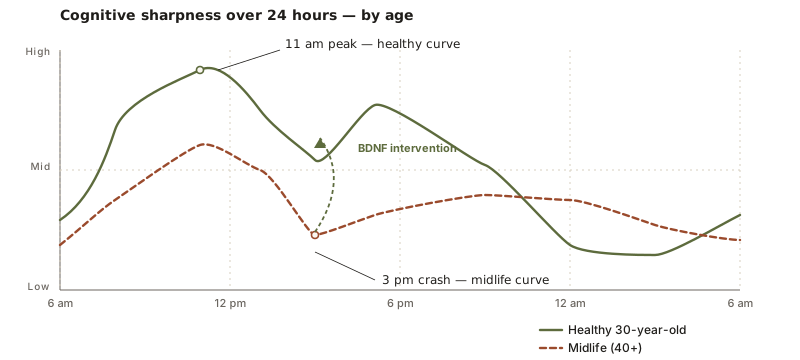
If you have brain fog over 40, the 3pm crash is the most distinctive marker. It's not a coincidence and it's not 'just blood sugar.' It's the moment in the day when BDNF supply is lowest relative to cognitive demand, and the bandwidth simply runs out. By 5pm you can do laundry. By 5pm you cannot read a contract.
Three signs your brain fog over 40 isn't 'just stress'
Stress fog and BDNF fog can look the same on a Wednesday. They look different across a full week. Watch for these three patterns.
1. The fog doesn't lift on a stress-free day. Saturday morning, no inbox, no children, just a coffee and a paper — and you still can't recall the name of the actor in the film you watched last week. Stress fog clears on Saturdays. BDNF fog does not.
2. You can't recall words you knew yesterday. Not 'occasionally I forget a word' — that happens at any age. The pattern to watch is words you actively used yesterday, gone today, retrieved an hour later. That latency change is BDNF, not stress.
3. Caffeine masks but doesn't fix. Two coffees push the fog back ninety minutes, then it returns harder. If you've noticed you're drinking more coffee for the same thinking output, you're medicating BDNF starvation with adrenaline. It works. It also gets worse.
What actually shifts BDNF — and where NeuroActiv6 fits
BDNF responds to three things, in this order. First, sustained aerobic exercise — at least 40 minutes, raised heart rate, three to five times a week. Second, deep sleep — particularly the slow-wave sleep that consolidates the day's learning. Third, specific nutrients: omega-3 DHA, blueberry polyphenols, curcumin, and a small set of nootropic compounds with reasonable mechanism evidence behind them.
NeuroActiv6 is the supplement we cover in this slot. It's a nootropic blend formulated around BDNF support: it pulls together omega-3 DHA, polyphenol-rich extracts, and a handful of additional compounds that research suggests may support cognitive performance over 40. We chose to cover it because the formulation aligns with what the research says actually moves BDNF, not because of marketing copy. NeuroActiv6 for cognitive support is the brand's own product page on Digistore24 — that link includes our affiliate disclosure, and you can read our full editorial standards for how we vet what we cover.
What we will not say: that NeuroActiv6 is a one-shot solution to brain fog, that it replaces sleep or exercise, or that the research is settled. Some users report a clearer 11am window inside three weeks. Some report no change. The research suggests the precursors matter; the timing of the suggestion ('with breakfast, daily, for at least 21 days') matters; and the rest of the protocol — sleep, cardio, sunlight — matters more than the supplement does. Treat it as one input among several, not a single answer.
What this looks like in practice
Most women who run the full protocol — daily cardio, prioritised sleep, BDNF-aligned nutrition with or without a nootropic — notice the change between weeks two and three. The 11am window is the first thing to come back. The 3pm crash softens later, usually weeks four to six. The wired-but-fuzzy evening is the last to shift, and it does shift, but it requires the sleep work to be holding. Skip the sleep and the rest of the stack underperforms.
The window for honest assessment is six weeks of consistent inputs — not three days of trying it. We'll keep covering BDNF, midlife cognition, and the related protocols on the blog — and we hold ourselves to real sourcing standards on every claim. If you've spent two years calling it stress and two years it hasn't lifted, the question to ask isn't whether you're stressed. It's whether your BDNF supply is keeping up with your cognitive load. The research says probably not.
Scientific Sourcing & Citations (2)
We link the published studies we reference so you can read them yourself.
- 1Frontiers in Cellular Neuroscience, 2014: BDNF levels and cognitive health across the midlife transition.
Clinical Finding
Documents that BDNF levels in the hippocampus decline gradually after age 40, resulting in reduced synaptic plasticity and working memory latency.
Journal Reference: Front. Cell. Neurosci., 2014
- 2NIH National Institute on Aging, 2021: Cognitive health, memory consolidation, and functional aging in midlife adults.
Clinical Finding
Tracks standard cognitive performance markers and demonstrates that working-memory bandwidth decreases due to sleep disruption and metabolic cortisol imbalances, independent of degenerative conditions.
Journal Reference: National Institute on Aging (NIH), 2021