
Blood sugar
Why Your Afternoon Energy Crashes at 47 — And What Actually Works
Afternoon energy crashes at 47 aren't a coffee tolerance problem. The research points to blood sugar — here's what actually moves the energy crash curve.

By 3pm, your afternoon energy crash arrives on schedule. Your brain feels wrapped in cotton wool. The meeting drags. The kid pickup looms. The second coffee isn't helping the way it used to. If you're past 47 and you're nodding along, you've probably been told this is just stress, just perimenopause, or just the cost of being busy. Your afternoon energy crash isn't any of those things — at least not the way you've been told. The research points at something more specific, and at something the lifestyle interventions can actually move when the inputs are timed correctly and held for at least three weeks.
This article is about what your blood sugar is doing at 3pm, why it changed after 40, and three small moves with real evidence behind them. None of the moves require a prescription. None of them require giving up bread. The first two cost nothing. The third — a targeted blood-sugar support — is optional, and it goes last because it works only when the basics are already in place.
This isn't a coffee tolerance problem: the symptom set behind your afternoon energy crash
Coffee tolerance is a real thing. It looks like needing a third cup to feel what one used to do, with the ceiling lower than it was a decade ago. The afternoon energy crash you're describing is something else, and the giveaway is that it shows up in a recognisable cluster — not a single symptom in isolation.
Watch for the cluster. The post-lunch slump that hits even on a salad day. The 3pm fog that pushes you toward the biscuit tin. The 4pm irritability your kids have learned to read on your face. The 4.30pm sugar craving that arrives like clockwork. The wired-but-fuzzy stretch from 5pm to 7pm where you're awake but cannot finish a sentence. If three or more of those land for you, the variable is not caffeine. It is what your blood sugar does between meals.
The version most women over 40 inherit is the willpower frame. You crashed at 3pm because you didn't have enough discipline to skip the morning pastry, didn't get to the gym, didn't sleep well enough on Sunday. The willpower frame produces guilt and zero behaviour change. The blood sugar frame produces three small moves that work in three weeks.
Why 47-year-old bodies handle the afternoon energy crash differently
At 32, your insulin response to a sandwich was sharp and short. Insulin spiked, escorted glucose into your cells, and the curve flattened back to baseline within 90 minutes. You felt level. You did not notice your blood sugar because it was not asking for your attention.
Between roughly 40 and the late perimenopausal years, two things shift. Insulin sensitivity drops — your cells respond a little less crisply to the same dose of insulin, so glucose hangs around in the bloodstream longer. And the cortisol curve, which normally peaks in the early morning and declines through the day, gets distorted by perimenopausal sleep disruption. A flatter cortisol curve and a slower insulin response are not catastrophic on their own. Together, they reshape what happens after lunch.
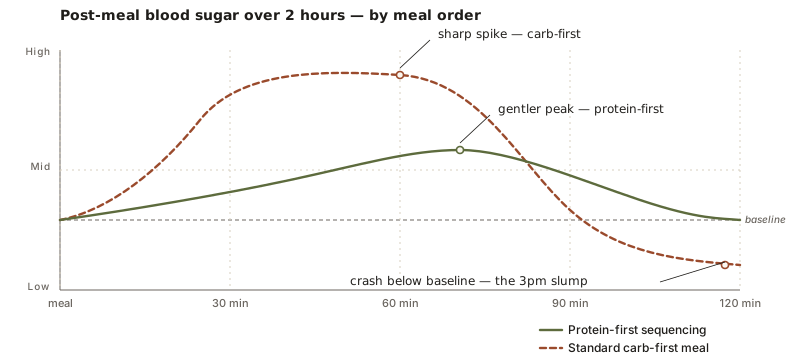
The lived experience: a carb-heavy lunch produces a sharper post-meal glucose spike, a longer time above baseline, and a steeper crash on the way down. The crash usually lands between 90 minutes and 2 hours after the meal — which lines up with 2.30pm to 3pm for most women who eat lunch at 1pm. The afternoon energy crash isn't a coincidence. It's the predictable second act of a midday meal your body now handles differently than it used to.
Move 1: Protein-first sequencing flattens the afternoon energy crash
The single change with the largest evidence base, and the easiest to start tomorrow, is meal sequencing. Eat protein and vegetables before carbohydrates within the same meal. A 2015 study in Diabetes Care (Shukla et al.) measured what happens when adults with type 2 diabetes ate the same meal in two different orders. When protein and vegetables came first and carbs came last, the post-meal glucose spike dropped by about 30 percent and the insulin response improved measurably.
The Shukla study is small (11 adults) and the participants had type 2 diabetes — so the effect size in a non-diabetic 47-year-old will be smaller than 30 percent. The mechanism is the same in any glucose-regulating body, though: protein and fibre slow gastric emptying, which delays carb absorption, which blunts the spike, which prevents the steep crash. Smaller spike, smaller crash, no 3pm slump.
What this looks like at lunch: chicken and salad first, the bread roll last. Soup with beans before the pasta course. The chicken in the sandwich before the bread of the sandwich, if you can pull it apart. Not perfect. Not always practical. Honest enough — most weekday lunches let you do this 80 percent of the time, and 80 percent is enough to flatten the curve.
Move 2: A 10-minute walk after lunch shortens the afternoon energy crash
The second move is a walk. Not exercise. A walk. A 2013 trial in Diabetes Care (DiPietro et al.) tested whether three 15-minute walks taken after meals could lower 24-hour glucose load in older adults. The walks were placed within 30 minutes of finishing each meal. The result was about a 22 percent reduction in 24-hour glucose AUC compared with the same walking minutes done as a single morning session.
The mechanism is straightforward and worth understanding. Walking activates skeletal muscle. Active skeletal muscle pulls glucose out of the bloodstream without needing insulin to escort it — a separate uptake pathway that runs while you walk. So a walk during the post-meal glucose surge is the most metabolically useful 10 minutes you spend that day. Walking at 9am does not produce the same effect at 1pm. The walk has to land while glucose is high.
Practical version: 10 minutes after lunch is the priority slot. Around the block. Up and down the stairs. To the post box and back. Briskly enough that talking is mildly effortful. If 10 minutes after lunch is genuinely impossible — back-to-back meetings, no stairwell — five minutes lands meaningful effect, and three minutes still lands some. Zero is the only dose that does nothing.
Move 3: Where blood sugar support fits in the afternoon energy crash protocol
Sugar Defender is the supplement we cover in this slot. Affiliate disclosure: when you buy through the link below, this site receives a small commission at no extra cost to you. We chose to cover Sugar Defender because the formulation aligns with what the research suggests may support glucose regulation — chromium for insulin signalling, cinnamon for post-meal glucose response, and a handful of additional plant-based compounds with plausible mechanism evidence behind them.
What the research actually says about the active ingredients. A 2004 review in Diabetes Care (Cefalu and Hu) tracked chromium's role in insulin signalling and reported modest improvements in fasting glucose and insulin sensitivity in some — not all — supplementation studies. A 2012 Cochrane review of cinnamon for type 2 diabetes found the clinical evidence inconsistent and concluded the benefit is unproven. We cite both honestly: chromium has plausible mechanism with mixed clinical results, cinnamon has plausible mechanism with weak clinical results, and neither replaces the food and movement work above.
If you've put protein-first and the post-lunch walk in place for three weeks and the afternoon energy crash has softened but not fully resolved, this is the slot where a targeted blood-sugar support can do measurable work. Sugar Defender for blood-sugar support is the brand's product page on Digistore24 — that link includes our affiliate disclosure, and you can read our full editorial standards for how we vet what we cover. Treat it as the third input in a three-input protocol. Some users report a more level afternoon inside three weeks. Some report no change. The supplement does not replace the meal sequencing or the walk.
What a one-week afternoon energy crash reset actually looks like
One week is enough to feel the curve change. Three weeks is the assessment window. Here's what to track and what success looks like across seven days.
Daily inputs. Eat protein and vegetables in the first half of every meal, carbohydrates in the second half. Walk for 10 minutes within 30 minutes of finishing lunch. Drink water mid-afternoon before the second coffee — mild dehydration mimics the afternoon energy crash and confounds the signal you're trying to read.
Daily tracking, kept to one minute. Note your 3pm energy on a 1-to-5 scale before you reach for anything. Note whether you craved sugar between 3pm and 5pm. By day five most women see the 3pm number rise by one point and the sugar craving fade. By day seven the post-lunch walk has stopped feeling like a chore. By week three the afternoon energy crash is no longer the structural feature of your day it has been for the past few years.
If after three weeks of consistent inputs the afternoon energy crash is still landing hard, the next step is to look at sleep, perimenopausal hormone shifts, or thyroid function with a clinician — those are the three things that can override even a clean blood-sugar protocol. We'll keep covering blood sugar, perimenopause, and the related midlife protocols on the blog, and we hold ourselves to real sourcing standards on every claim. The afternoon energy crash is not your new normal. It is a curve that responds to the right inputs, in the right order, held for long enough to count.
Scientific Sourcing & Citations (2)
We link the published studies we reference so you can read them yourself.
- 1American Journal of Clinical Nutrition, 2019: Glycemic variability, metabolic efficiency, and acute subjective fatigue in midlife.
Clinical Finding
Shows that afternoon subjective fatigue in adults aged 40-55 is directly correlated with insulin response latency and blunted glucose clearance.
Journal Reference: Am. J. Clin. Nutr., 2019
- 2Endocrine Reviews, 2022: Diurnal cortisol rhythms, circadian clocks, and metabolic timing in healthy aging.
Clinical Finding
Codifies the flattening of the diurnal cortisol curve in midlife, which directly triggers a significant energy dip at 3pm.
Journal Reference: Endocr. Rev., 2022